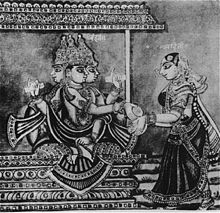
ORIGIN: Hindu (Vedic)
The first mention of Aditi is found in Rigveda, which is dated by mainstream consensus to have been composed between 1800 and 1200 BC. She is portrayed as the mother of the Adityas, a group of societal Rigvedic deities, including Varuna, Mitra, Aryaman, Daksha, Bhaga, Amsha, and sometimes Surya and Savitar. As the mother of the societal deities, she represented the compliance to social behavior. Her motherhood was also an important attribute, and later was expanded so that she became the mother of all deities.
According to the Shatapatha Brahmana (a commentary on the Shukla Yajurveda), Aditi is also invoked during ritual sacrificial offerings as being synonymous with the Earth:
'On the navel of the earth I place thee!' And further, 'In the lap of Aditi (the boundless or inviolable earth)!' for when people guard anything very carefully, they commonly say that 'they, as it were, carried it in their lap;' and this is the reason why he says, 'In the lap of Aditi!'
— Satapatha Bramanda (translator Julius Eggeling, 1882), 1:1:2:23
TYPE: Archaic mother goddess
INFORMATION: According to the Rg Veda Aditi is said to be the wife of Kasyapa or of Brahma and mother of the Adityas, a group of minor gods including Mitra, Aryaman, Bhaga, Varuna, Daksa, and Anisa. No other consort is mentioned in the literature. She is also considered to be the mother of Hari. Other legends give her as the mother of the rain god Indra. No human physical features are drawn, though she is sometimes identified in the guise of a cow. Aditi is also perceived as a guardian goddess who brings prosperity and who can free her devotees from problems and clear away obstacles. She disappears largely from later Hindu traditions.
Aditi ('boundless' or 'limitless'or 'innocence') is an important Vedic goddess in Hinduism. She is the personification of the sprawling infinite and vast cosmos. She is the goddess of motherhood, unconsciousness, the past, the future and fertility. She is the mother of the celestial deities known as the adityas, and is referred to as the mother of many deities. As celestial mother of numerous beings, the synthesis of all things, she is associated with space (akasa) and with mystic speech (Vac). She may be seen as a feminised form of Brahma and associated with the primal substance (mulaprakriti) in the Vedanta. She is mentioned more than 250 times in the Rigveda, the verses replete with her praise.
FAMILY: Aditi is the eldest daughter of Daksha and Asikni (Panchajani). The Puranas, such as the Shiva Purana and the Bhagavata Purana, suggest that Daksha married all of his daughters off to different people, including Aditi and 16 others to Kashyapa rishi. When Kashyapa was living with Aditi and Diti in his ashrama, he was really pleased with Aditi's services and told her to ask for a boon. Aditi prayed for one ideal son. Accordingly, Indra was born. Later, Aditi gave birth to others, namely Varuna, Parjanya, Mitra, Ansh, Pushan, Dhatri, Aryaman, Surya, Bhaga, Savitr, Indra and Lord Vamana. Her 16 younger sisters were also married to Sage Kashyap.
ATTRIBUTES:
AFFILIATION: Devi
WEAPONS: Sword, Trishula
MOUNT: Phoenix
TEXTS: Rg Veda, Puranas, Ramayana, Mahabharata
PARENTS: Daksha (Father), Asikni (Mother)
SIBLINGS: Diti, Kadru, Vinata, Sati, Smriti, Swaha, Rohini, Revati, Danu, Muni, and many other brothers and sisters.
CONSORT: Kashyapa
CHILDREN: Adityas, Indra, Surya, Bhaga, Varuna, Mitra, Aryaman, Savitr, Vamana