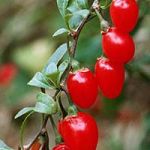
| Common Name: |
Duke of Argyll's Tea Tree |
| Other Names: |
Boxthorn, Matrimony vine, Wolfberry |
| Botanical Name: |
Lycium barbarum syn. L. halimifolium |
| Genus: |
Lycium |
| Family: |
Solanaceae |
| Cultivation: |
Sandy, alkaline, moist but well-drained soil in sun. Remove dead wood in winter and cut back to control growth in spring. Prune plants grown for commercial use two to three times a year to encourage a compact, well-branched shrub for heavier fruiting and easier harvesting. |
| Propagation: |
By seed sown in autumn; by softwood cuttings in summer; by hardwood cutting in winter. |
| Harvest: |
Bark is stripped from roots in winter and dried for decoctions, pills, and powders. Fruits are collected in autumn and dried for decoctions. |
| Native Location: |
S Europe to China |
| Height: |
3.5m (11ft) |
| Width: |
5m (15ft) |
| Hardiness: |
Z5-9 |
| Parts Used: |
Root bark (di gu pi), fruits (gou qi zi). |
| Properties: |
Fruits produce a sweet, tonic decoction that lowers blood pressure and cholesterol levels, acting mainly on the liver and kidneys. The bitter, cooling, anti-bacterial root bark controls coughs and lowers fevers, blood pressure, and cholesterol levels. |
| Medicinal Uses: |
Internally for high blood pressure, diabetes, poor eyesight, vertigo, lumbago, impotence, and menopausal complaints (fruits); chronic fevers, internal hemorrhage, nosebleed, tuberculosis, coughs, asthma, plantar warts, and childhood eczema (root bark). Externally for genital itching. |
| Culinary Uses: |
Fruits are added to Chinese tonic soups. Leaves used for making tea, notably Essential Harmony, a classic Chinese herbal tea. |
| Economic Uses: |
Fruit extracts are added to soft drinks. |
| Bibliography: |
Encyclopedia of Herbs by Deni Brown. Copyright © 1995, 2001 Dorling Kindersley Limited. pg 267
|