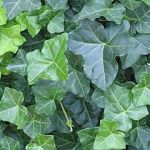
English Ivy


English Ivy

This genus of 9-11 species of evergreen woody climbers and creepers occurs in Europe, Asia, N Africa, the Canary Islands, Madeira, and the Azores. There are over 300 cultivars of English Ivy, Hedera helix, which are popular as ornamentals for groundcover, training on surfaces or as topiary, and for the containers. Ivy was sacred to Dionysus (Bacchus), the god of wine; if bound to the brow, it was reputed to prevent intoxication. Wreaths of ivy symbolize fidelity and were part of the marriage ceremony in ancient Greece. They were banned by the early Christian church as a pagan custom. Ivy contains emetine, an amebicidal alkaloid also found in Cephaelis ipecacuanha (See, ipecac), and triterpene saponins, which are effective against liver flukes, mollusks, intestinal parasites, and fungal infections. Hedera is the original Latin name for ivy.

Variable, self-clingin, evergreen climbing or carpet-forming perennial, with stems clad in adventitious roots and dark green, broadly ovate to triangular, 3- to 5-lobed leaves, 4-6cm (1½-2½in) long. Small yellow-green flowers, rich in nectar, appear in rounded umbels in autumn on mature plants, followed by globose, black berries, 7mm (¼in) across.


Common Name:
English Ivy
Botanical Name:
Hedera helix
Genus:
Hedera
Family:
Araliaceae
Native Location:
Europe
Cultivation:
Any soil or situation, except waterlogged. Tolerates heavy shade. Plant young climbers horizontally to encourage lateral climbing shoots. Variegated cultivars are often less hardy and need more light. Trim to shape in spring and summer to control new growth. Scale insects, spider mites, and leaf spot may damage leaves.
Propagation:
By separation of rooted sections; by semi-ripe cuttings in summer. Use juvenile growth for climbers, and mature growth for a bushy, non-climbing habit.
Harvest:
Leaves are picked and used fresh for decoctions, liquid extracts, ointments, poultices, and tinctures, or macerated in vinegar.
Height:
10-30m (30-100ft)
Width:
5m (15ft)
Variations:
Buttercup
Has bright yellow, 5-lobed leaves (pale green when grown in shade), excellent for a sunny wall.
Height: 2m (6ft)

Erecta
Is an upright, bushy, non-climbing ivy, more vigorous than "Congesta", and with more rounded leaves.
Height: 1m (3ft)
Width: 1.2m (4ft)

Glacier
Has small gray-green leaves, marbled silver-gray and cream, popular as a houseplant.
Height: 3m (10ft)
Width: 2m (6ft)

Goldheart
syn.Jubiläum Goldherz, Oro di Bogliasco
Has 3-lobed, dark green leaves with a yellow central blotch; excellent for walls.
Height: 8m (25ft)
Weight: 3m (10ft)

Ivalace
syn. Mini Green
Has dark green, 5-lobed leaves with curly margins; good for walls, groundcover or containers.
Height: 1m (3ft).

Pedata
syn. Caenwoodiana (bird's foot ivy)
Has gray-green, 5-lobed leaves, each with an elongated central lobe and backward pointing basal lobes.
Height: 4m (12ft)

Sagittifolia Variegata
syn. Ingelise
Has cream-variegated, medium-sized, five-lobed leaves. Good for walls.
Height: 2m (6ft)

Spetchley
Has tiny, dark green leaves, 5-15mm (¼-½in) long, usually with three lobes. Tends to revert.
Height: 1m (3ft)
Hardiness:
Z4-9
Parts Used:
Leaves.
Properties:
A bitter, aromatic, anti-bacterial herb with a nauseating taste. It lowers fever, relaxes spasms, is expectorant, and constricts veins.
Medicinal Uses:
Internally for gout, rheumatic pain, whooping cough, and bronchitis. Excess destroys red blood cells and causes irritability, diarrhea, and vomiting. Externally for burns, warts, impetigo, scabies, skin eruptions, swollen tissues, painful joints, neuralgia, toothache, and cellulitis. For use by qualified practioners only.
Warning:
All parts, especially young leaves and berries are harmful if eaten. Severe skin irritant and allergen.
Bibliography:
Encylopedia of Herbs by Deni Brown Copyright ©: 1995, 2001 Dorling Kindersley Limited pg 231