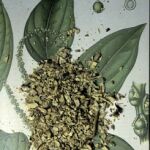
| Common Name: |
Kava Kava |
| Other Names: |
Ava, Ava Pepper, Intoxicating Pepper, Kava |
| Botanical Name: |
Piper methysticum |
| Genus: |
Piper |
| Family: |
Piperaceae |
| Native Location: |
Islands of Oceania |
| Cultivation: |
Rich, well-drained soil in light shade and high humidity (P. longum, P. nigrum). Deep, rich soil, including heavy clay, ample moisture and shade (P. betle, P. cubeba). P. auritum thrives in full sun. Well-drained, stony soil, with ample water and humidity, in sun (P. methysticum). Plants are usually grown on frames. Remove weak of congested stems in late winter or early spring before new growth begins. For optimum fruiting (P. nigrum), cut back young plants to 30cm (12in) several times a year to stimulate growth of shoots, retaining the ten strongest, and tying in at each node. Mature vines are pruned regularly to 4m (12ft). Susceptible to fungal root rot, pepper weevil, and pepper flea beetle. |
| Propagation: |
By seed sown at 20-24°C (66-75°F); by semi-ripe cuttings in summer. |
| Harvest: |
Leaves are picked as required (P. auritum), blanched in the dark, often pressed together, and dried for extracts or to use whole (P. betel). Roots are lifted as required, usually from plants about 2m (6ft) tall, and used fresh, or dried for use in decoctions, liquid extracts, powders, and tablets (P. methysticum). Fruits are picked unripe and distilled for oleo-resin and oil, or dried for use in liquid extracts, powders and tinctures (P. cubeba). Fruit clusters are picked unripe and dried for use whole, ground or in decoctions (P. longum). Fruits of P. nigrum are picked unripe and used fresh, pickled (green peppercorns), and dried (green and black peppercorns); or ripe, and retted for eight days before drying (white peppercorns); black peppercorns are ground or decocted for medicinal use. |
| Height: |
3-6m (9-18ft) |
| Width: |
2-5m (6-15ft) |
| Hardiness: |
Min. 15-18°C (59-64°F) |
| History: |
Kava, a native plant of Melanesia and Polynesia, may be the newest and trendiest of the "natural" stress-busting herbs used in America, but for centuries South Pacific islanders have used kava root as an intoxicating, ceremonial drink integral to many of their sacred rituals. The herb has also been used in Europe for more than 200 years—after the eighteenth-century British explorer James Cooke brought the plant back from one of his trips to the South Pacific. Though the herb's sedating effects were well known in Europe in the eighteenth and nineteenth centuries, kava was used to treat a variety of medical conditions. For over 100 years, kava was the standard treatment for gonorrhea, incontinence, vaginitis, and other genitourinary ailments. It was also employed as a local anesthetic and pain reliever. In the 1950s, researchers began studying the plant's chemical components and discovered that kava was unique among anxiety-relieving herbs and conventional drugs. It induces a relaxed, meditative state, but it does not block emotions or dull the senses like other antianxiety medications, such as Valium and Ativan. Instead, kava elevates mood and increases mental awareness. |
| Parts Used: |
Roots |
| Properties: |
A bitter, very pungent, warming herb with a lilac aroma. It acts as a diuretic, increases perspiration, relieves pain, relaxes spasms, has relaxant and locally anesthetic effects, and is reputedly aphodisiac. |
| Medicinal Uses: |
Internally for anxiety, tension, insomnia, genito-urinary infections, gall bladder complaints, gonorrhea, arthritis, and rheumatism; externally for joint pains, toothache, and mouth ulcers. Contraindicated during pregnancy and lactation, and in endogenous depression. Excess causes stupor; prolonged use may cause temporary yellowing of skin, hair and nails. May cause drowsiness. Taking in conjunction with alcohol or barbiturates may potentiate inebriation.
Kava has antianxiety, antispasmodic, diuretic, pain-relieving, relaxant, sedating, and sleep-promoting properties. IT also stimulates the circulatory and central nervous system. It is taken internally for anxiety, arthritic pain, gallbladder ailments, headache, insomnia, joint pain, menstrual cramps, muscle pain and spasms, rheumatism, stress, and genitourinary infections. |
| Preparation: |
Kava is widely available as dried herb and in commercially prepared capsules, teas, and tinctures; follow the manufacturer's or your practitioner's directions. The chemicals in kava responsible for its calming effects are called kavalactones, and they are extracted from the plant's roots. Commercial preparations of kava vary greatly in potency, depending on the percent of kavalactones they contain—anywhere from 3 percent (for mild sedating action) to 30 percent (for strong sedating action). Consult your practitioner about the best dosage and potency for you. In commercial teas, kava is often combined with other calming herbs, such as chamomile, lavender, and passionflower. |
| Caution: |
Take kava only at recommended doses—preferably under the direction of a medical practitioner—and for no more than three months. Overconsumption of kava or long-term use may result in motor and vision problems; muscle weakness; skin, hair, and nail discoloration; skin rashes and scaling; and swollen face and eyes. Do not take kava if you are pregnant or nursing, or if you have been diagnosed with depression or Parkinson's disease. Do not combine alcohol and kava, and exercise caution when driving or operating machinery until you know the herb's effects. Do not combine kava with prescription or antianxiety or sleep medications; oversedation may occur. Mild side effects may include headaches, sleepiness, and upset stomach. |
| Culinary Uses: |
Chewed, fermented roots are the basis of ritual Polynesian drink that has a calming effect, but promotes mental awareness. |
| Bibliography: |
Encyclopedia of Herbs by Deni BrownCopyright © 1995, 2001 Dorling Kindersley Limited. pp. 319-321
The Modern Herbal Primer by Nancy Burke Copyright©2000 Yankee Publishing, Inc. pp. 73-74 |