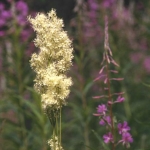
| Common Name: |
Meadowsweet |
| Other Names: |
Bridewort, Dolloff, Dropwort, Meadow Queen, Meadow Wort, Meadsweet, Meadwort, Pride of the Meadow, Queen of the Meadow |
| Botanical Name: |
Filipendula ulmaria |
| Genus: |
Filipendula |
| Family: |
Rosaceae |
| Native Location: |
Europe, and W Asia |
| Cultivation: |
Rich, moisture-retentive to wet soil in sun or partial shade. Dislikes acid soil; prone to powdery mildew in dry conditions. |
| Propagation: |
By seed sown in autumn and left to overwinter, or in spring at 10-13°C (50-55°F); by division in autumn or spring; by root cuttings from late winter to early spring. |
| Harvest: |
Plants are cut as flowering begins and dried for use in tablets, infusions, decoctions, liquid extracts, and tinctures. Flowers may be gathered seperately to make infusions. |
| Variations: |
Aurea
Has yellow new foliage, turning pale golden-green in summer. It is less vigorous than the species and scorches in full sun.
Height: 30-45cm (12-18in)
Width: 30cm (12in)
Flore Pleno
Has long-lasting, double flowers.
Variegata
Has leaves irregularly splashed with yellow, fading to cream in summer. |
| Height: |
60cm-1.2m (2-4ft) |
| Width: |
60cm (2ft) |
| Hardiness: |
Z3-9 |
| History: |
Many of us only know meadowsweet as a delightfully fragrant ornamental plant. Its almond-scented, cream-colored flowers and wintergreen-scented leaves have made it the centerpiece of many a bridal bouquet—as well as a time-honored strewing herb, much used at court (it was a favorite of England's Elizabeth I) and in homes from the Middle Ages through the eighteenth century. Today, it is still sprinkled along church aisles at weddings. Meadowsweet's flowers and leaves were often used to flavor wines and beers, and during the fourteenth century it was a key ingredient in the honey-and-wine brew called mead. Meadowsweet was also one of the ancient Druid's three sacred herbs. The other two were vervain and water mint. Few people know that meadowsweet is also a centuries-old medicinal herb, and one of the best for treating infections, fever, pain, and stomach upsets. But the pharmaceutical industry knew about meadowsweet. Over 100 years ago, researchers identified meadowsweet as on the plants rich in salicin, the chemical precursor of salicylate, a potent pain-reliever and fever-reducer. Scientists used the salicin from meadowsweet and similar plants (white willow is another), to "invent" aspirin, the most celebrated drug in pharmaceutical history. Unfortunately, the same scientists didn't isolate the stomach-soothing properties also present in meadowsweet, and aspirin, while still one of the greatest scientific discoveries, is notoriously tough on the tummy. Meadowsweet isn't. |
| Parts Used: |
Whole Plant, flowers |
| Properties: |
An astringent, aromatic, antacid herb that heals, soothes, and relieves pain, especially in the joints and digestive tract. It is effective against organism causing diphtheria, dysentery, and pneumonia. |
| Medicinal Uses: |
Internally for hyperacidity, heartburn, gastritis, and peptic ulcers, for which meadowsweet is among the most effective of plant remedies. Also for diarrhea in children, dysentery, rheumatic and joint pains, influenza, and cystitis. Combined with Althaea officinalis (See, Marshmallow) and Melissa offinalis (See, Balm Melissa) for gastric complaints.
To treat cough, bronchitis, gout, headaches, stomach ulcers, diarrhea, and rheumatism of the joints. Germany's Commission E has approved the use of meadowsweet flower to treat cough, bronchitis, colds and fever and the use of meadowsweet herb to treat cough and bronchitis.
Meadowsweet has antacid, anti-inflammatory, antiseptic, astringent, diuretic, pain-relieving, and sweat-promoting properties. It is taken internally for colds, cystitis, diarrhea, dysentery, fever, flu, gastritis (heartburn), joint pain, pneumonia, and ulcers. |
| Preparation: |
Meadowsweet is available as dried herb and in capsules, teas, and tinctures. To make a tea, pour 1 cup of boiling water over 2 teaspoons of dried herb and steep for 15 minutes. Strain, and drink up to 3 cups a day. |
| Warning: |
Not given to patients with hypersensitivity to salicylates (aspirin).
Do not give meadowsweet to children under 16 if they have a cold, flu, or other viral symptoms. The salicylic acid in the herb may cause Reye's syndrome, a potentially fatal illness. Do not take meadowsweet with other salicylates, such as aspirin, wintergreen, or white willow because of the risk of additive effects. |
| Typical Dose: |
A typical daily dose of meadowsweet may range from 2.5 to 3.5 gm of meadowsweet flower or 4 to 5 gm of meadowsweet herb. |
| Possible Side Effects: |
Meadowsweet's more common side effects (flower or herb) include nausea, vomiting, anorexia, and allergic reactions. |
| Drug Interactions: |
| Taking meadowsweet with these drugs may increase the risk of bleeding or bruising: |
| Abciximab, (ReoPro) |
Antithrombin III, (Thrombate III) |
Argatroban, (Argatroban) |
Aspirin, (Bufferin, Ecotrin) |
Bivalirudin, (Angiomax) |
| Celecoxib, (Celebrex) |
Dalteparin, (Fragmin) |
Danaparoid, (Orgaran) |
Enoxaparin, (Lovenox) |
Etodolac, (Lodine, Utradol) |
| Fondaparinux, (Arixtra) |
Heparin, (Hepalean, Hep-Lock) |
Ibuprofen, (Advil, Motrin) |
Indomethacin, (Indocin, Novo-Methacin) |
Ketoprofen, (Orudis, Rhodis) |
| Ketorolac, (Acular, Toradol) |
Lepirudin, (Refludan) |
Meloxicam, (MOBIC, Mobicox) |
Naproxen, (Aleve, Naprosyn) |
Piroxicam, (Feldene, Nu-Pirox) |
| Rofecoxib, (Vioxx) |
Ticlopidine, (Alti-Ticlopidine, Ticlid) |
Tinzaparin, (Innohep) |
Urokinase, (Abbokinase) |
Warfarin, (Coumadin, Jantoven) |
| Taking meadowsweet with these drugs may interfere with absorption of the drug: |
| Ferric Gluconate, (Ferrlecit) |
Ferrous Fumarate, (Femiron, Feostat) |
Ferrous Gluconate, (Fergon, Novo-Ferrogluc) |
| Ferrous Sulfate, (Feratab, Fer-Iron) |
Ferrous Sulfate and Ascorbic Acid, (FeroGrad 500, Vitelle Irospan) |
Iron-Dextran Complex, (Dexferrum, INFeD) |
| Polysaccharide-Iron Complex, (Hytinic, Niferex) |
|
| Culinary Uses: |
Flowers are preserved as syrup or used to flavor stewed fruits. |
| Economic Uses: |
Flowers and Leaves are used to flavor herbal beers and liqueurs and non-alcoholic herbal drinks, such as Norfolk Punch. |
| Bibliography: |
Encyclopedia of Herbs by Deni Brown Copyright © 1995, 2001 Dorling Kindersley Limited Pg 214
The Essential Herb-Drug-Vitamin Interaction Guide by Geo. T. Grossberg,MD and Barry Fox,PhD Copyright©2007 Barry Fox,PhD Pp 338-339
The Modern Herbal Primer by Nancy Burke Copyright©2000 Yankee Publishing, Inc. pp.79-80 |