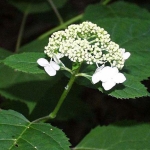
| Common Name: |
Wild Hydrangea |
| Other Names: |
Seven barks |
| Botanical Name: |
Hydrangea arborescens |
| Genus: |
Hydrangea |
| Family: |
Hydrangeaceae |
| Native Location: |
E USA |
| Cultivation: |
Moist, well-drained, rich soil in sun or partial shade, avoiding early morning sun in frosty areas. Cut back previous year's flowering shoots in early spring. Remove dead flower heads. |
| Propagation: |
By seed sown in spring; by softwood cuttings in summer; by hardwood cuttings in winter. |
| Harvest: |
Roots are lifted in autumn and dried for decoctions, liquid extracts, and tinctures. |
| Height: |
1-3m (3-10ft) |
| Width: |
1.2-2.5m (4-8ft) |
| Variations: |
Annabelle
Has spherical flower heads, 20cm (8in) across, and withstands wind and rain better than the other sterile forms.
Subsp. Discolor "Sterilis" syn "Sterilis"
Has leaves with gray-green, hairy undersides, and flower heads with large sterile flowers.
Grandiflora
Produces flowerheads smaller than "Annabelle", but the individual sterile flowers are larger. |
| Hardiness: |
Z4-10 |
| Parts Used: |
Roots |
| Properties: |
A sweet, pungent herb that is antiseptic and diuretic, soothes irritated tissues, and reduces formation of urinary stones. |
| Medicinal Uses: |
Internally for kidney and bladder stones, cystitis, urethritis, prostatitis, rheumatoid arthritis, gout and edema. Works well with Aphanes arvensis (See parsley piert), Arctostaphylos uva-ursi (See, bearberry), and Eupatorium purpureum (See, boneset). Excess may cause dizziness and bronchial congestion. |
| Bibliography: |
Encyclopedia of Herbs by Deni Brown Copyright © 1995, 2001 Dorling Kindersley Limited. pp 238-239 |