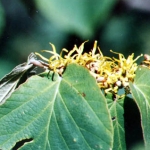
| Common Name: |
Witch Hazel |
| Other Names: |
Common Witch Hazel, Hamamelis, Hazel, Snapping Hazel, Spotted Alder, Striped Alder, Tobacco Wood, Winterbloom |
| Botanical Name: |
Hamamelis virginiana |
| Genus: |
Hamamelis |
| Family: |
Hamamelidaceae |
| Native Location: |
East N America |
| Cultivation: |
Moist, rich, neutral to acid soil in sun or partial shade. Cut back rangy growths after flowering. |
| Propagation: |
By seed sown when ripe; by suckers. Germination is slow and erratic and may take up to two years. |
| Harvest: |
Leaves are picked in summer for dry and liquid extracts and ointments. Branches are cut in spring and decorticated for use in tinctures. Twigs are cut in spring for use in distilled extracts. |
| Height: |
5m (15ft) |
| Width: |
4m (12ft) |
| Hardiness: |
Z4-9 |
| History: |
A revered herb among many Native North American tribes—who used decoctions of the plant's bark and leaves to treat bleeding, inflammations, insect bites, sore eyes, and muscle aches—witch hazel has been used traditionally and famously as an astringent. It is probably the most commercially and widely available of the medicinal herbs, known to all as the ubiquitous Witch Hazel, and alcohol-distilled form of the herb from which the volatile oil has been removed. Some scholars believe witch hazel's unusual common name come from an early association with witchcraft; others believe the name is a corruption of the Old English word for "pliant"—a reference to the fact that the plant's branches were easily bent into bows. Witch hazel's Latin name is a derivation of the apple family's genus name, Malus, and pays homage to witch hazel's resemblance to the apple tree. |
| Parts Used: |
Leaves, branches, bark. twigs. |
| Chemical Constituents: |
Bitters
Calcium Oxalate
Gallic Acid
Hamamelitannin
Hexose sugar
Tannins
Volatile Oils
|
| Properties: |
An astringent, slightly aromatic herb that checks bleeding and mucous discharge, and reduces inflammation. |
| Known Effects: |
Shrinks tissues (when used as ointment, solution, suppository) |
| Possible Additional Effects: |
May treat diarrhea
May soothe irritated skin or hemorrhoids
Potential astringent (non-distilled form only)
|
| Medicinal Uses: |
Internallyfor diarrhea, colitis, dysentery, hemorrhoids, vaginal discharge, excessive menstruation, hemorrhage in stomach or lungs, and prolapsed organs. Externally for varicose veins, sprains, bruises, burns, hemorrhoids, sore nipples, muscular aches, eye and skin inflammations, and sore throat. Combined with Agrimonia eupatoria (See, agrimony) and Quercus robur (See, English oak) for diarrhea; with Plantago major (See, broad-leaved plantain) or Ranunculus ficaria (See, lesser celandine) for hemorrhoids; with Aesculus hippocastanum (See, common horse chestnut) and Calendula officinalis (See, calendula) for varicose veins.
To treat wounds, diarrhea, hemorrhoids, and menstrual complaints. Germany's Commission E has approved the topical use of witch hazel bark and leaf to treat hemorrhoids, skin inflammation, problems with veins, and wounds and burns. It has approved the use of witch hazel leaf for treating inflammation of the mouth and throat.
Witch hazel has anti-inflammatory, astringent, sedating, and tonic properties. It also stops bleeding and dries up excessive mucus. While some older herbals recommend taking a witch hazel decoction internally for colitis, diarrhea, and vaginitis, we recommend witch hazel only for external application. It is applied directly to the skin, in liquid or oil form, to treat bleeding, bruising, hemorrhoids, insect bites, irritated eyes, minor burns, and skin inflammations, muscle aches and sprains, sunburn, and varicose veins. Witch hazel is also used as an aftershave lotion, cosmetic astringent, and skin cleanser. |
| Preparation: |
Commercial, distilled witch hazel is widely available and is an effective remedy for minor skin irritations and inflammations. Follow the manufacturer's directions. Tinctures of witch hazel—which is available in herb shops and health food stores—is much stronger than the distilled herb and may be prescribed for more serious conditions; however, it should only be taken under the direction of a qualified practitioner. Consult your practitioner about the best way to use witch hazel. |
| Typical Dose: |
A typical dose of witch hazel leaf may range from 2 to 3 gm of the herb in 150 ml of water as a gargle solution. |
| Warnings and Precautions: |
Do not ingest witch hazel.
Don't take if you:
Are pregnant, think you may be pregnant, or plan pregnancy in the near future
Have any chronic disease of the gastrointestinal tract, such as stomach or duodenal ulcers, reflux esophagitis, ulcerative colitis, spastic colitis, diverticulosis, or diverticulitis
Consult your doctor if you:
Take this herb for any medical problem that doesn't improve in 2 weeks (There may be safer, more effective treatments.)
Take any medicinal drugs or herbs including, aspirin, laxatives, cold and cough remedies, antacids, vitamins, minerals, amino acids, supplements, other prescription or non-prescription drugs
Pregnancy:
Dangers outweigh any possible benefits. Don't use.
Breastfeeding:
Dangers outweigh any possible benefits. Don't use.
Infants and Children:
Treating infants and children under 2 with any herbal preparation is hazardous.
Others:
None are expected if you are beyond childhood, under 45, not pregnant, basically healthy, take it only for a short time and do not exceed manufacturer's recommended dose.
Storage:
Store in cool, dry area away from direct light, but don't freeze
Store safely out of reach of children
Don't store in bathroom medicine cabinet. Heat and moisture may change the action of the herb.
Safe Dosage:
Consult your doctor for the appropriate dose for your condition.
|
| Possible Side Effects: |
Witch hazel should not be taken internally, as it may cause nausea, vomiting, constipation, and possible liver damage. When used topically, which hazel may cause allergic reactions. |
| Drug Interactions: |
| Taking witch hazel internally with these drugs may increase the risk of hypertension (high blood pressure): |
| Ephedrine, (Pretz-D) |
Ergotamine, (Cafergor, Cafergot) |
Rizatriptan Benzoate, (Maxalt) |
Zolmitriptan, (Zomig) |
| Taking witch hazel internally with these drugs may reduce or prevent absorption of the drug: |
| Ferric Gluconate, (Ferrlecit) |
Ferrous Fumarate, (Femiron, Feostat) |
Ferrous Gluconate, (Fergon, Novo-Ferrogluc) |
Ferrous Sulfate, (Feratab, Fer-Iron) |
| Ferrous Sulfate and Ascorbic Acid, (FeroGrad 500, Vitelle Irospan) |
Iron-Dextran Complex, (Dexferrum, INFeD) |
Polysaccharide-Iron Complex, (Hytinic, Niferex) |
|
| Toxicity: |
Rated relatively safe when taken in appropriate quantities for short periods of time. |
| Disease Effects: |
Gastrointestinal disturbances may be caused or worsened and liver damage may occur with long-term internal administration of witch hazel. |
| Adverse Reactions, Side Effects, or Overdose Symptoms: |
| Signs and Symptoms: |
What to do: |
|
| Constipation |
Discontinue. Call doctor when convenient. |
| Jaundice (yellow skin and eyes) |
Discontinue. Call doctor immediately. |
| Nausea or Vomiting |
Discontinue. Call doctor immediately. |
|
| Economic Uses: |
Distilled witch hazel is an important ingredient of eye drops, skin creams, ointments, and skin tonics. |
| Bibliography: |
The Encyclopedia of Herbs by Deni Brown Copyright © 1995, 2001 Dorling Kindersley Limited. pg 230.
The Essential Herb-Drug-Vitamin Interaction Guide by Geo. T. Grossberg,MD and Barry Fox,PhD Copyright©2007 Barry Fox,PhD. Pp.493-494
The Modern Herbal Primer by Nancy Burke Copyright©2000 Yankee Publishing, Inc. pg.130
Vitamins, Herbs, Minerals & Supplements The Complete Guide by H. Winter Griffith, MD Copyright©1998 Fisher Books pp. 462-463 |