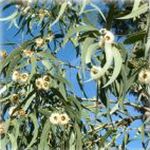
| Common Name: |
Eucalyptus |
| Other Names: |
Blue Gum, Blue Gum Tree, Fever Tree, Gum Tree, Stringy Bark Tree, Tasmanian Blue Gum |
| Botanical Name: |
Eucalyptus globulus |
| Genus: |
Eucalyptus |
| Family: |
Myrtaceae |
| Cultivation: |
Fertile, well-drained neutral to acid soil in sun; E. camaldulensis thrives in moist to wet soil and shallow water. Young specimens make good container plants for cool areas but do not thrive long-term in pots. Eucalyptus citriodora and E. globulus may be grown as annuals for summer bedding or containers. Prone to silver leaf, edema, and psyllids. |
| Propagation: |
By seed sown in spring or summer 13-18°C (55-64%deg;F). Cut back in spring only to restrict size or to retain juvenile foliage. |
| Harvest: |
Leaves are cut as required and dried for decoctions and infusions, or distilled for oil. Kino is collected from bark incisions and dried for use in lozenges, powders, and tinctures. |
| Native Location: |
To moist valleys in uplands of New South Wales and Victoria
Australia, Algeria, Southern China, Egypt, India, South Africa, Spain, California |
| Height: |
15-45m (50-150ft) |
| Width: |
10-25m (30-80ft) |
| Extraction: |
Steam Distillation |
| Hardiness: |
Z9-10 |
| History: |
The nineteenth-century German explorer and botanist Ferdinand von Müller—who was the director of the Melbourne Botanical Gardens for 15 years—introduced the wonders of Australia's eucalyptus tree to the rest of the world in the 1850s. Soon the wondrously smelling tree had traveled to Africa, Europe, and North and South America. Australian aboriginal, who called the family of trees eucalypts, used the herbs as a source of medicine, food, and water. Oil extracted from the leaves was used to treat wounds. The roots of the small eucalyptus trees were eaten as vegetables. Parasites who lived on the trees excreted a deliciously sweet and edible syrup, called "manna" by the aboriginals, which could be added to foods and drinks. Perhaps most importantly, thte substantial roots of the larger eucalyptus trees stored considerable quantities of water, even in arid terrain. A native could dig up these roots, slice off an end, and collect the drinkable water stored therein. This unusual feature of eucalyptus's roots made it an invaluable weapon against malaria. In Algeria (and other parts of Africa), as well as in Italy, when eucalyptus trees were planted in swampy areas infested by malaria-carrying mosquitoes, the roots of the trees drained the swamps, which, in turn, eliminated the mosquitoes—and the malaria. And if that weren't enough, eucalyptus proved to be a fine, multipurpose medicinal, too. |
| Parts Used: |
Leaves, oil extracted from leaf and branch tips. |
| Properties: |
An aromatic, stimulant, decongestant herb that is expectorant, relaxes spasms, and lowers fevers. It is effective against many bacteria, especially staphylococci
Antiseptic, expectorant, slightly antispasmodic, mildly astringent, analgesic, rubefacient, bactericidal, antiviral. |
| Color and Odor: |
The essential oil is colorless and has a distinct, crisp, camphoraceous odor that is penetrating and refreshing. |
| Planet: |
Mercury |
| Background: |
It was introduced to Europe and the rest of the world from Australia in 1857. The trees are usually planted in swampy areas to prevent the spread of malaria. However, when grown outside Australia it tends to secrete substances that inhibit the growth of surrounding plants. |
| Element: |
Air |
| Magical Influences: |
Health, Purification, Healing. |
| Uses: |
- Respiratory Sytem—An extremely effective remedy for reducing body temperature in all type of fever. Valuable as a decongestant for catarrh in most respiratory infections including colds, influenza, sinusitis, tuberculosis and throat infections, especially when there is a purulent mucus discharge. Provides good protection during epidemics. Eucalyptus is useful for hayfever.
- Nervous System—Analgesic in neuralgia and congestive headaches.
- Muscular Sytem—Good for general muscular aches and pains.
- Skeletal System—Beneficial for rheumatoid arthritis and helps to remove toxins in the joints.
- Skin—Good for skin eruptions, shingles, herpes, indolent wounds, ulcers and burns.
- Emotions—Clears the head of mental exhaustion and the inability to concentrate. Balances extremes of the mood. Eucalyptus cools heated emotions when people are engaged in any form of combat, be it verbal, emotional or physical. It's aroma creates a feeling of space.
|
| Blends: |
| RESPIRATORY |
NERVOUS |
MUSCULAR |
| Eucalyptus 7 |
Eucalyptus 7 |
Eucalytptus 6 |
| Pine 3 |
Lavender 4 |
Chamomile (R) 5 |
| Benzoin 3 |
Peppermint 2 |
Lavender 3 |
|
| SKELETAL |
SKIN |
EMOTION |
| Eucalyptus 7 |
Eucalyptus 5 |
Eucalyptus 5 |
| Juniper 4 |
Lavender 4 |
Lemon 4 |
| Rosemary 3 |
Tea Tree 3 |
Basil 3 |
|
| Medicinal Uses: |
Externally, in inhalations and vapor rubs, for mucus, bronchitis, sinusitis, colds, and influenza; in liniments for bruises, sprains, and muscular pains; in ointments, for wounds and abscesses. Excess causes headaches, convulsions, and delirium and may prove fatal.
Eucalyptus leaf is used to treat asthma, fever, whooping cough, loss of appetite, diabetes, and fever. Eucalyptus oil is used to treat asthma, emphysema, cough, ulcers, wounds, burns, and rheumatism. Germany's Commission E has approved the use of eucalyptus leaf to treat coughs and bronchitis and eucalyptus oil to treat rheumatism, bronchitis, and cough.
Eucalyptus has antibacterial, antiseptic, antispasmodic, antiviral, blood-sugar-lowering, decongestant, expectorant, fever-reducing, and stimulant properties. It is used externally—as an inhalant and in oils and ointments—to treat bacterial infections, bronchitis, bruises, colds, congestions, coughs, fevers, flu, muscle aches and spasms, sinus infections, and wound. |
| Preparation: |
Eucalyptus is widely available in commercially prepared bath additives, cough drops, creams, oil, and ointments. Follow the manufacturer's or your practitioner's directions. |
| Typical Dose: |
The average daily dose of eucalyptus is 1.5 gm of the leaf taken several times a day. A typical internal dose of eucalyptus oil may range from 0.3 to 0.6 gm, while externally several drops of the essential oil may be rubbed onto the skin. |
| Caution: |
Despite the practice of some herbalists who prescribe small amounts of eucalyptus oil for internal consumption, we strongly caution you against taking eucalyptus internally; it is extremely toxic, even in small amounts. If you are insulin-dependent, consult your practitioner about how to use eucalyptus externally. |
| Possible Side Effects: |
Eucalyptus's side effects include dizziness, seizures, nausea, loss of appetite, and confusion. |
| Warning: |
Subject to legal restrictions some countries in the form of eucalyptus oil.
Skin irritant. |
| Drug Interactions: |
| Taking eucalyptus with these drugs may increase the risk of hypoglycemia (low blood sugar): |
| Acarbose, (Prandase, Precose) |
Acetohexamide, (Acetohexamide) |
Chlorpropamide, (Diabinese, Novo-Propamide) |
Gliclazide, (Diamicron, Novo-Gliclazide) |
| Glimepiride, (Amaryl) |
Glipizide, (Glucotrol) |
Glipizide and Metformin, (Metaglip) |
Gliquidone, (Beglynor, Glurenorm) |
| Glyburide, (DiaBeta, Micronase) |
Glyburide and Metformin, (Glucovance) |
Insulin, (Humulin, Novolin R) |
Metformin, (Glucophage, Riomet) |
| Miglitol, (Glyset) |
Nateglinide, (Starlix) |
Pioglitazone, (Actos) |
Repaglinide, (GlucoNorm, Prandin) |
| Rosiglitazone, (Avandia) |
Rosiglitazone and Metformin, (Avandamet) |
Tolazamide, (Tolinase) |
Tolbutamide, (Apo-Tolbutamide, Tol-Tab) |
| Taking eucalyptus with these drugs may reduce the effectiveness of the drug: |
| Amobarbital, (Amytal) |
Amobarbital and Secobarbital, (Tuinal) |
Butabarbital, (Butisol Sodium) |
Butalbital, Acetaminophen, and Caffeine, (Esgic, Fioricet) |
| Butalbital, Aspirin, and Caffeine, (Fiorinal) |
Mephobarbital, (Mebaral) |
Methohexital, (Brevital, Brevital Sodium) |
Pentobarbital, (Nembutal) |
| Phenobarbital, (Luminal Sodium, PMS-Phenobarbital) |
Primidone, (Apo-Primidone, Mysoline) |
Secobarbital, (Seconal) |
Thiopental, (Pentothal) |
|
| Disease Effects: |
- May interfere with attempts to control blood sugar in diabetes.
- May worsen disease of the liver or gastrointestinal tract.
|
| Supplement Interactions: |
Increased risk of additive toxicity when eucalyptus oil is used with herbs and supplements containing unsaturated pyrrolizidine alkaloids (UPAs), such as Butterbur, Comfrey, and Colt's Foot. |
| Economic Uses: |
Used as a flavoring in pharmaceutical products and in spot removers for oil and grease. An important lumber species, used for the keels of ships in the 19th century. Widely planted to dry out swampy ground, notably in Italy and California. |
| Bibliography: |
Encyclopedia of Herbs by Deni Brown. Copyright © 1995, 2001 Dorling Kindersley Limited. pp 206-207
Aromatherapy Blends and recipes by Franzesca Watson Copyright © 1995 Thorsons, Harper Parker Publishing Inc. Pp 100-101
Magical Aromatherapy by Scott Cunningham Copyright © 1989 Llewellyn Publications, Inc. Pp 84
The Essential Herb-Drug-Vitamin Interaction Guide by Geo. T. Grossberg,MD and Barry Fox,PhD Copyright©2007 Barry Fox,PhD. Pp.208-209
The Modern Herbal Primer by Nancy Burke Copyright©2000 Yankee Publishing, Inc. pp. 141-142
|