| Common Name: |
Fennel |
| Other Names: |
Bitter Fennel, Fenkel, Fenouil, Finocchio, Herb Fennel, Sweet Fennel, Wild Fennel |
| Botanical Name: |
Foeniculum vulgare |
| Family: |
Apiaceae |
| Location: |
S. Europe; Naturalized in N Europe, Australia, and Elsewhere, Mediteranean, Bulgaria, France, Germany, Hungary, Italy, Portugal, Spain, North Africa, North America |
| Cultivation: |
Light, well-drained, neutral to alkaline soil in full sun. Foeniculum vulgare is not reliably hardy in areas with cold, wet winters; var dulce needs rich, light soil, a warm position, and ample moisture to produce compact "bulbs" that are hilled up as they develop. The flowers attract beneficial insects, such as hoverflies, parasitic wasps, and tachinid flies, which prey on garden pests. Fennel should not be planted near beans, kohlrabi, or tomatoes, as it is said to affect their growth adversely, and also that of Coriandrum sativum (See, Cilantro). Fennel and Anthethum graveolens (See, Dill), should not be grown close together since hybridization produces seedlings with an indeterminate flavor. Subject to statuatory control as a weed in some countries, notably in parts of Australia. |
| Propagation: |
By seed sown in spring at 13-18°C (55-64°F); by division in early spring; var. dulce is grown as a half-hardy annual. "Purpureum" comes true from seed. Fennel self-seeds freely in light soils. |
| Harvest: |
Leaves are picked for use at any time during the growing season; leaf bases are most tender in spring. Stems for use in cooking are cut as required. Roots are lifted in autumn and dried for use in decoctions. Unripe seeds are collected in summer for using fresh. Ripe seeds are harvested before they fall by cutting the seedheads and upturning into a paper bag for drying; they are used whole, ground, or distilled for oil. |
| Height: |
2m (6ft) |
| Width: |
45cm (18in) |
| Hardiness: |
Z4-10 |
| Variations: |
Var. dulce syn. Var. Azoricum
(Florence Fennel, Sweet Fennel, Finocchio)
Is a smaller plant with bulbous stalk bases
Height: 60cm (24in)
Width: 45cm (18in). |
Mammoth
Is a slow-bolting Florence Fennel, best sown in autumn. |
Perfection
Is a fast-growing Florence fennel, developed for northern climates. |
Purpureum
(Bronze Fennel)
Has deep brown foliage and is slightly hardier than the species. |
Smokey
Is a superior bronze fennel with a sweet, licorice-like flavor. |
|
| Plant Facts: |
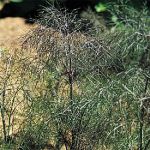
This perennial and biennial plant is a member of the Apiaceae family. It emits a very spicy odor and its seeds have a strong anise taste. The fennel plant will grow in full sun to about 5 feet tall with dark green leaves, yellow flowers and oval seeds. |
| History: |
The ancient Greeks and Romans prized fennel for its medicinal, culinary, and magical values. Almost 2,500 years ago, the Greek physician Hippocrates recommended fennel for nursing mothers to increase the flow of breast milk. The herb was prominently featured in several Greek myths: Aphrodite planted fennel at the graveside of her beloved Adonis; Prometheus hid the fire that he stole from Mount Olympus inside a giant fennel plant. The early Greeks also discovered fennel's lesser known appetite-suppressing action and called the herb marathron, a derivation of the Greek maraino, meaning "to become thin". The word's other obvious reference—to athletics—isn't accidental. Ancient Greek athletes (as well as Greek soldiers and Roman gladiators) ate fennel to increase their strength and endurance, and the victorious in all arenas were often crowned with wreaths of fennel. Five hundred years later, the Roman scholar and historian, Pliny, recorded over 20 medicinal uses for fennel, most notably for improving eyesight—after he made the unusual observation that snakes who had just shed their skins also rubbed their "faces" against the fennel plant, supposedly to renew their vision as well. Both the Greeks and Romans used fennel as a spice and a staple vegetable crop, and the Romans gave the herb its official name, Foeniculum, for the Latin foenum for "hay". Fennel was equally famed as a magical talisman. Among the early Germanic tribes of Britain, fennel—like chamomile—was revered as one of the nine sacred herbs that could dispel evil spirits. This belief continued through the Middle Ages, when fennel was placed in keyholes and hung over doorways to protect homes and churches from demons. Fennel's sweet but heady licorice scent also made it a fine strewing herb for the home; it effectively masked all manner of unpleasant odors and had the added benefit of repelling insects. In colonial America, the Puritans—who were required to fast before and during church services that went on for hours—chewed on fennel seeds both to quell their hunger pangs and to quiet their grumbling stomachs. |
| Origin: |
Fennel originated in the Mediterranean region, where it is still found in the wild. Today fennel is cultivated as a vegetable or seed-bearing plant in the temperate zones of both Europe and Asia. |
| Components: |
The essential oil in fennel seeds contains anethol—which relieves cramps—fenchone— which stimulates the appetite. |
| Indications: |
Drinking a tea infused from fennel seeds may help relieve mild digestive problems while the fresh root can be used as a diuretic. |
| Daily Ritual: |
Rising daily with a fennel-seed mouthwash is a good way to keep the lining of your mouth clean and healthy. This rinse will also inhibit the formation of tooth decay and keep your breath fresh. |
| Extraction: |
Steam Distillation |
| Parts Used: |
Seeds, Fennel seeds are most often used in natural remedies, but the leaves and roots also have medicinal value. Seeds that are collected in late summer are particularly rich in active constituents. Roots that are dug up in spring before the leaves have come out also offer greater medicinal power.
Leaves, stems, roots, seeds, oil of seeds. |
| Color and Odor: |
The essential oil is colorless and has a very sweet and somewhat warm, anisic aroma. |
| Background: |
Known to the early Greeks and Romans and grown in Europe as a popular vegetable often eaten with fish. Fennel is one of the main constituents of babies' gripe water. |
| Properties: |
Carminative, diuretic, stimulant, antispasmodic, anti-inflammatory, tonic
A sweet, aromatic, diuretic herb that relieves digestive problems, increases milk flow, relaxes spasms, and reduces inflammation. |
| Vitamin Content: |
Vitamin A, Thiamin |
| Precautions: |
Bitter fennel oil has been determined to be hazardous. Use with caution and do not take internally. |
| Drug Interactions: |
| Taking fennel with these drugs may lower the seizure threshold: |
| Amitriptyline, (Elavil, Levate) |
Amoxapine, (Asendin) |
Bupropion, (Wellbutrin, Zyban) |
Ciprofloxacin, (Ciloxan, Cipro) |
| Desipramine, (Alti-Desipramine, Norpramin) |
Doxepin, (Sinequan, Zonalon) |
Fosphenytoin, (Cerebyx) |
Carbamazepine, (Carbatrol, Tegretol) |
| Ganciclovir, (Cytovene, Vitrasert) |
Imipramine, (Apo-Imipramine, Tofranil) |
Levetiracetam, (Keppra) |
Methylphenidate, (Concerta, Ritalin) |
| Metoclopramide, (Apo-Metoclop, Reglan) |
Metronidazole, (Flagyl, Noritate) |
Moxifloxacin, (Avelox, Vigamox) |
Nortriptyline, (Aventyl HCl, Pamelor) |
| Ofloxacin, (Floxin, Ocuflox) |
Olanzapine, (Zydis, Zyprexa) |
Oxcarbazepine, (Trileptal) |
Phenytoin, (Dilantin, Phenytek) |
| Prochlorperazine, (Compazine, Compro) |
Quetiapine, (Seroquel) |
Tramadol, (Ultram) |
Venlafaxine, (Effexor) |
| Taking fennel with these drugs may increase skin sensitivity to sunlight: |
| Bumetanide, (Bumex, Burinex) |
Celecoxib, (Celebrex) |
Ciprofloxacin, (Ciloxan, Cipro) |
Doxycycline, (Apo-Doxy, Vibramycin) |
| Enalapril, (Vasotec) |
Etodolac, (Lodine, Utradol) |
Fluphenazine, (Modecate, Prolixin) |
Fosinopril, (Monopril) |
| Furosemide, (Apo-Furosemide, Lasix) |
Gatifloxacin, (Tequin, Zymar) |
Hydrochlorothiazide, (Apo-Hydro, Microzide) |
Hydrochlorothiazide and Triamterene, (Dyazide, Maxzide) |
| Ibuprofen, (Advil, Motrin) |
Indomethacin, (Indocin, Novo-Methacin) |
Ketoprofen, (Orudis, Rhodis) |
Ketorolac, (Acular, Toradol) |
| Lansoprazole, (Prevacid) |
Levofloxacin, (Levaquin, Quixin) |
Lisinopril, (Prinivil, Zestril) |
Loratadine, (Alavert, Claritin) |
| Methotrexate, (Rheumatrex, Trexall) |
Naproxen, (Aleve, Naprosyn) |
Nortriptyline, (Aventyl HCl, Pamelor) |
Ofloxacin, (Floxin, Ocuflox) |
| Omeprazole, (Losec, Prilosec) |
Phenytoin, (Dilantin, Phenytek) |
Piroxicam, (Feldene, Nu-Pirox) |
Prochlorperazine, (Compazine, Compro) |
| Quinapril, (Accupril) |
Risperidone, (Risperdal) |
Rofecoxib, (Vioxx) |
Tetracycline, (Novo-Tetra, Sumycin) |
| Taking fennel with these drugs may reduce blood levels of the drug: |
| Ciprofloxacin, (Ciloxan, Cipro) |
Levofloxacin, (Levaquin, Quixin) |
Moxifloxacin, (Avelox, Vigamox) |
|
| Planet: |
Mercury |
| Element: |
Air |
| Magical Influences: |
Longevity, Courage, Purification. |
| Uses: |
- Digestive Sytem—An excellent carminative and digestive remedy for indigestion and flatulence. Tones the muscles of the digestive tract. Counteracts the effects of alcohol consumption; useful for recovering alcoholics.
- Urinary System—Fennel's cleansing action clears toxins from the body. It's diuretic action promotes the flow of urine and helps with water retention and obesity.
- Reproductive Sytem—Helps to regulate menstruation when periods are scanty and painful. Valuable for threating menopausal problems. Also promotes lactation.
- Skeletal System—Helpful for gouty conditions.
- Skin—Valuable for treating cellulite by helping to detoxify the accumulation of wastes.
- Emotions—Fennel energizes, comforts and enlivens the mind. It induces a sense of courage, caution and calmness.
|
| Medicinal Uses: |
Internally for indigestion, gas, colic, and insufficient lactation (seeds), urinary disorders (root). Externally as a mouthwash or gargle for gum disease and sore throat. Combines with Chamaemelum nobile (See, Roman Chamomile), Filipendula ulmaria (See, Meadowsweet), Geranium maculatum (See, American Cranesbill), and Mentha x. piperita (See, Peppermint) for digestive problems, and with Arctostaphylos uva-ursi (See, Bearberry) for cystitis. Oil is combined with oils of Eucalyptus globulus (See, Eucalyptus) and Thymus vulgaris (See, Thyme), and diluted with vegetable oil as a rub for bronchial congestion; also added to laxative preparations to prevent griping and to "gripe water" for babies: not given to pregnant women.
To treat various skin ailments, fish tapeworms, bronchitis, and menstrual irregularities; to aid digestion; to increase the libido. Germany's Commission E has approved the use of fennel oil and seed to treat cough, bronchitis, and dyspeptic complaints such as heartburn and bloating.
Fennel has antiflatulence, anti-inflammatory, antispasmodic, appetite-suppressant, diuretic, expectorant, liver-nourishing, and stomach-soothing properties. It also stimulates the uterus and increases milk production in nursing mothers. Fennel is most frequently prescribed for abdominal and intestinal cramping, congestive coughs, flatulence, indigestion, nausea, and upset stomachs. The herb also suppresses the appetite and is used as a diet aid. |
| Preparation: |
Fennel is available as dried and roasted seeds, fresh and dried leaves, and in oils, teas, and tinctures. The whole plant, including the root and bulb, can be eaten raw or cooked. The seeds are famously used, of course, in cooking. To make a tea, pour 1 cup of boiling water over 1 tablespoon of crushed seeds and steep for 10 minutes. Strain, and drink 1/3 cup, three times a day. To make a stomach-soothing, gas-relieving fennel milk toddy, simmer 1 teaspoon of fennel seeds in 1 cup of milk for 10 minutes. Drink Hot. |
| Typical Dose: |
A typical dose of fennel may range from 0.1 to 0.6 ml of fennel oil, taken three times a day following meals. |
| Caution: |
No serious side effects are associated with taking fennel. If you are pregnant, do not take fennel medicinally—it is a uterine stimulant. Do not harvest fennel in the wild unless you are an expert in identifying herbs. Wild fennel closely resembles the very poisonous hemlock plant (Conium maculatum), and both plants grow in the same areas. |
| Possible Side Effects: |
Fennel's side effects include lack of appetite, skin sensitivity to light, nausea, and vomiting. |
| Disease Effects: |
This herb may have estrogen-like effects and should not be used by women with estrogen-sensitive breast cancer or other hormone-sensitive conditions. |
| Culinary Uses: |
Leaves are eaten in salads, and as a garnish and flavoring, especially with snails, olives, and fish dishes, such as pasta con le sarde (Sicily). Leaf bases, especially of the variety dulce are eaten raw in salads (as cartucci in Italy) or cooked as a vegetable. Whole, cracked, or ground seeds are used to flavor bread, biscuits, sausages (notably finocchiona, an Italian salami), and stuffings. Flower heads are used to flavor capers. Dried stems are used in barbecuing fish. Seeds or leaves are used to make herb tea. |
| Economic Uses: |
Fennel oil is used as a flavoring in the food industry, and in liqueurs, such as Fenouillette and Sambuca; also in toothpastes, soaps, air fresheners and perfumes. |
| Blends: |
| DIGESTIVE |
URINARY |
REPRODUCTIVE |
| Fennel 6 |
Fennel 6 |
Fennel 5 |
| Orange 4 |
Juniper 4 |
Cypress 4 |
| Peppermint 2 |
Rosemary 3 |
Clary Sage 3 |
|
| SKELETAL |
SKIN |
EMOTION |
| Fennel 6 |
Fennel 5 |
Fennel 5 |
| Lemon 4 |
Celery 4 |
Lemon 4 |
| Chamomile (G) 2 |
Juniper 4 |
Juniper 3 |
| Methods of Administration: |
- Tea or Infusions:
Infuse 1 tsp. of fennel seeds in 1 cup of boiling water and steep for 10 min. Uncrushed seeds will yield a sweet-tasting tea infusion. Crushed seeds will taste stronger and more bitter.
- Eyewash:
Briefly boil 1 tbsp. of fennel seeds in 1 cup of water. Add 1 tsp. of eyebright and ¼ tsp. of salt; steep for 10 min. Strain the mixture through a linen cloth, taking care to filter well. Use the mixture of herbs remaining in the cloth as an eye compress and the strained liquid to rinse the eyes. Always prepare only enough eye rinse to be used a ta single time. Storing unused eyewash for later use is not reccommended.
- Compress:
Pour boiling wqater over a handful of fennel leaves and seeds. Allow to steep overnight. Put the plant parts in a linen cloth and place on any painful area.
- Labeled Products:
Commercially, look for fennel syrup, honey, teas, tinctures and candies. Fennel is also available in many combination products on the market.
|
| Bibliography: |
Aromatherapy Blends and recipes by Franzesca Watson Copyright © 1995 Thorsons, Harper Parker Publishing Inc. Pp 102-103
Magical Aromatherapy by Scott Cunningham Copyright © 1989 Llewellyn Publications, Inc. Pp 84-85
The Complete Natural Guide to Healing Group 1 Card 15
The Encyclopedia of Herbs by Deni Bown Copyright©2005 Dorling Kindersley Limited. Pp.214-215
The Essential Herb-Drug-Vitamin Interaction Guide by Geo. T. Grossberg,MD and Barry Fox,PhD. Copyright©2007 Barry Fox,PhD. Pp.215-216
The Modern Herbal Primer by Nancy Burke Copyright©2000 Yankee Publishing, Inc. pp.56-58 |
|