Juniper


Juniper

About 50-60 species of coniferous trees and shrubs belong to this genus, which occurs throughout the northern hemisphere. Junipers are popular ornamentals, with a great variety of size, habit, and color. Most have two kinds of foliage: scale-like adult leaves and pointed juvenile leaves. Juniperus communis is a widely distributed and exceptionally variable species; it thrives on both acid and limestone soils. Many of its variants are propagated vegetatively from male plants and do not bear "berries". Juniper is perhaps best known as the principal flavoring of gin; the word "gin", a shortened form of the Dutch genever, is derived from the Latin juniperus. In medicinal terms, it is one of the most effective herbal remedies for cystitis. Various other junipers are used medicinally. Native N Americans treated a wide range of illnesses, from kidney complaints to dandruff and syphilis, with extracts of J. scopulorum (Rocky Mountain juniper). J. virginiana (red cedar) was used for ailments such as coughs and colds, headaches, dysentery, and mumps. Red cedar oil is pleasantly aromatic but extremely toxic. Its use in inducing abortion carries considerable risk. Juniperus sabina (savin) is also considered too poisonous for internal use because it contains podophyllotoxin (as found in Podophyllum peltatum, See, may apple), which destroys cells and hs resulted in fatalities. Prickly juniper (J. oxycedrus) yields cade oil or juniper tar oil, a red-brown to black, oily liquid that controls itching and is used in tropical preparations for eczema, psoriasis, and seborrhea.

Juniper berries are the key flavor ingredient in gin, and indeed the name "juniper" comes from the French word genievre, which means "gin". The ancients recommended that those who indulged in too much gin drink a tea made from juniper berry as a hangover remedy. Juniper is used today as an antiflatulent, diuretic, and treatment for urinary tract infections, gastrointestinal disorders, and inflammation.

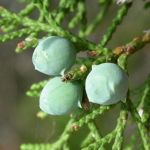
The evergreen juniper may grow as a shrub that sprawls on the ground or stand erect as a bush that grows to 12 feet tall. It bears needles, yellow flowers and blue berries that turn black upon maturity. These ripened berries are the source of the aromatic juniper essential oil. Its spicy, pinelike scent has earthy undertones, and it is most notably associated with the characteristic smell of gin, to which juniper berries are added for flavoring. The oil, however, has been used for medicinal purposes for many years. Juniper essential oil fights infections, warms and soothes painful arthritic joints, and minimizes the pain from muscle spasms. It can also speed the healing of cuts and bruises. Since it helps to rid the body of toxins and purify the skin, the oil may even relieve cellulitis. In addition, it can ease anxiety and calm irritable nerves during times of stress and overwork. And, the oil is cleansing to more than the spirit; the antiseptic action of juniper oil makes an excellent addition to water used for housecleaning.

Juniper oil's most important constituents are pinene, terpinen and terpineol. These make the oil quite useful for increasing circulation, fighting skin inflammations, such as acne, and easing joint and muscle pain. Juniper oil also lifts the spirits and balances emotions.

The scent of juniper oil has been associated with improved overall health. It is astringent and helps balance mood swings.

The juniper tree is a small evergreen growing to about 9 m with short spiny leaves and berries which are blue-black in color. The berries take about two years to ripen. It is commonly fourn all over Europe in chalky or lime soils.

Upright, spreading, or prostrate shrub with red-brown, papery bark and juvenile foliage only, consisting of whorls of three linear, sharply pointed, dark greed to blue-green leaves, about 1cm (3/8in) long, that have a single white stripe on the inner surface. Tiny ovoid male cones and globose female cones are produced on separate plants, followed on females by spherical


Common Name:
Juniper
Other Names:
Common Juniper, Enebro, Ginepro, Juniper Berry
Botanical Name:
Juniperus communis
Genus:
Juniperus
Family:
Cupressaceae
Native Location:
Northern Hemisphere, North America, Northern Europe, Siberia, Southwest Asia
Cultivation:
Moist soils in sun or light shade. Tolerates acid and alkaline conditions, dry and wet soils, and exposed positions. Plants may be damaged by various pests and diseases.
Propagation:
By seed sown when ripe; by ripewood cuttings in early autumn. Germination may take up to 5 years.
Harvest:
Fruits are gathered by shaking branches over a groundsheet; they are used fresh for oil distillation, or dried for infusions, liquid extracts, tablets, and tinctures.
Height:
0.5-6m (18in-20ft), occasionally 12m (40ft)
Width:
1-6m (3-20ft)
Variations:
Depressa
Is prostrate, with upturned shoot tips and leaves with very narrow white bands.
Native Location: North America
Height: 60cm (2ft)
Width: 1.5m (5ft)
Hardiness:
Z2-8
Parts Used:
Fruit ("berries"), oil.
Direction:
South
Magical Purpose:
Balefire
Deities:
Inanna, Ishtar
Planet:
Sun
Element:
Fire
Magical Effects:
Protection, Purification, Healing
Extraction:
Steam distillation
Color and Odor:
The essential oil is colorless and has a fresh, pleasing aroma.
Background:
Known by the ancient Egyptians and Greeks and used to combat epidemics. Around the time of the First World War, French hospitals used juniper in the sick wards as incense to combat diseases such as smallpox. Juniper berries are used in making gin.
Magical Influences:
Magical energy, Physical energy, Sex, Love, Money, Courage.
Properties:
A bitter, aromatic herb that is antiseptic and diuretic, improves digestion, stimulates the uterus, and also reduces inflammation.
Antiseptic, Antirheumatic, depurative, diuretic, detoxifying, emmenagogic, purifying, rubefacient, stimulant, tonic.
Medicinal Uses:
Internally for cystitis, urethritis, kidney inflammation, rheumatism, gout, arthritis, and poor digestion with gas and colic. Externally for rheumatic pain and neuralgia. Combines well with Aphanes arvensis (See, marshmallow) or Zea mays (See, corn). Contraindicated during pregnancy and in kidney disease or kidney infection.
To treat digestive problems, gout, arteriosclerosis, halitosis, and menstrual pain; to regulate menstruation. Germany's Commission E has approved the use of juniper to treat dyspeptic complaints, such as heartburn and bloating.
Typical Dose:
A typical daily dose of juniper may range from 2 to 10 gm of the dried berry or 20 to 100 mg of the essential oil.
Possible Side Effects:
Juniper's side effects include kidney irritation. Topically, juniper can cause eye and skin irritation.
Drug Interactions:
Taking juniper with these drugs may cause or worsen kidney damage:
Etodolac, (Lodine, Utradol)
Ibuprofen, (Advil, Motrin)
Indomethacin, (Indocin, Novo-Methacin)
Ketoprofen, (Orudis, Rhodis)
Ketorolac, (Acular, Toradol)
Meloxicam, (MOBIC, Mobicox)
Methotrexate, (Rheumatrex, Trexall)
Miglitol, (Glyset)
Morphine Hydrochloride, (Morphine Hydrochloride)
Morphine Sulfate, (Kadian, MS Contin)
Naproxen, (Aleve, Naprosyn)
Nitrofurantoin, (Furadantin, Macrobid)
Ofloxacin, (Floxin, Ocuflox)
Penicillin, (Pfizerpen, Wycillin)
Piroxicam, (Feldene, Nu-Pirox)
Propoxyphene, (Darvon, Darvon-N)
Rifampin, (Rifadin, Rimactane)
Stavudine, (Zerit)
Sucralfate, (Carafate, Sulcrate)
Valacyclovir, (Valtrex)
Vancomycin, (Vancocin)
Zidovudine, (Novo-AZT, Retrovir)
Taking juniper with these drugs may interfere with the effects of the drug and increase the risk of hyperglycemia (excessively high blood sugar):
Insulin, (Humulin, Novolin R)
Metformin, (Glucophage, Riomet)
Miglitol, (Glyset)
Pioglitazone, (Actos)
Repaglinide, (GlucoNorm, Prandin)
Rosiglitazone, (Avandia)
Taking juniper with this drug may be harmful:
Lithium, (Eskalith, Carbolith)—may increase the risk of drug toxicity.
Lab Test Alterations:
May confound results of diagnostic urine tests that rely on color change, as large amounts of juniper berry can turn the urine purple.
Disease Effects:
  • May worsen inflammatory or infectious gastrointestinal ailments by irritating the gastrointestinal tract.
  • May worsen seizure disorders.
Culinary Uses:
Juniper berries are used to flavor pickling brine, sauerkraut, stuffings, pâtés, game, ham, and pork.
Economic Uses:
Juniper extracts and oil are used to flavor gin, beers (genevrette), liqueurs (ginepro), and meat products. Oil is also used in spicy fragrances.
Warning:
Junipers may cause skin irritation and allergic responses.
Like all essential oils juniper should never be taken internally. Avoid using the oil if you have kidney problems or are pregnant, since it may prove too stimulating. Remember to dilute it with a carrier oil, such as sweet almond, before applying it to your skin.
Uses:
  • Digestive Sytem—Useful for indigestion, minor stomach upsets, flatulence and colic.
  • Urinary System—Juniper is a strong antiseptic and diuretic for treating cystitis and kidney inflammation. Good for relieving water retention.
  • Respiratory Sytem—A respiratory tract antiseptic, juniper is also good for convulsive coughs.
  • Skeletal System—Arthritic and joint problems, such as gout will benefit from juniper.
  • Skin—Good for disorders of the skin. Cleansing and toning, juniper is especially useful for treating oily skin and acne. Detoxifying for cellulite.
  • Emotions—Useful for treating sleep difficulties due to worry and tension. Juniper strengthens anyone feeling emotionally drained. It is particularly good for cleansing the mind of negative vibes accumulated from others. It revitalizes people who are cold and aloof and feel as though they are misunderstood and unsupported.
Aromatherapy Applications:
To Enhance your Mood
The fresh scent of juniper oil can eliminate crankiness and irritability caused by tension. The following mixture in an aromatherapy lamp helps calm stress and anxiety.
4 Drops Juniper Oil
2 Drops Lavender Oil
2 Drops Clary Sage Oil
For a Warming Bath:
Combine 3 drops each of Juniper and Rosemary oils, and mix the blend well into your bathwater. This uplifting mixture will stimulate blood flow, induce sweat, eliminate toxins, and clear your mind.

Sitz Bath For Hemorrhoids:
Mix 1 drop each of Juniper and Roman Chamomile Oils into a warm sitz bath. Sit for five minutes to allow the oil's properties to help relieve painful hemorrhoids.
For Meditation:
Juniper cleanses the atmosphere or a room and supports meditation. Add a few drops of Juniper and Frankincense to self lighting charcoal blocks to create a custom incense.

Toner For Oily Skin:
To combat oily skin, combine 1 drop of Juniper Oil with 1/2 cup of Witch Hazel and 1/2 cup of cool water, and shake well. Cleanse your skin with cotton pads soaked in the rinse. This toner works to help protect against additional infection of inflammation.
For Joint Pain:
Mix 4 drops of Juniper Oil, 4 drops of Lavender Oil, and 2 Drops of Rosemary Oil with 1/4 cup of either sweet-almond oil or another base oil of your choice. Gently massage your skin with this blend; it may alleviate and soothe any muscles and joints that are sore and painful due to arthritis.

For Cellulitis:
Juniper's stimulating effect on circulation counteracts cellulitis and firms the connective tissue. Blend 2 drops of Juniper oil, 2 drops of Cypress oil and 2 drops of Orange oil in approximately 3 tbsp. of sweet almond oil. Before taking a shower, massage the affected areas with a skin brush. Shower, and apply the oil blend to the flushed areas; massage the area with a circular motion.
To Relax Muscles:
Add 4 drops of juniper oil, 3 drops of Rosemary oil and 4 drops of Lavender oil to 1 cup of sea salt. Add the mix to your bathwater; bathe for about 20 min., and then rest for 1 hr. to avoid excess stimulation.

Aromatic Hair Treatment:
Be kind to your hair by applying an aromatic hair oil. Combine 6 drops of juniper oil with 1/2 oz. of jojoba oil. Put oil in you hands and run it throughout your hair. Leave it on for 1 hr and rinse.
Skin Treatment for Pets:
For improving a pet's skin while bathing, add 4 drops of juniper essential oil to the bathwater. Another effective pet formula is 5 drops of juniper oil and 10 drops of Lavender blended in an 8 oz. spritz bottle of water; use it to spray a pet's sleeping quarters or the areas they frequent in the home. Add 2 drops of Eucalyptus to the spray to help freshen your pet's sleeping quarters and deter unwanted fleas and ticks.
Blends:
DIGESTIVE URINARY RESPIRATORY
Juniper 7 Juniper 6 Juniper 6
Parsley 3 Celery 4 Eucalyptus 3
Fennel 2 Sandalwood 2 Sandalwood 3

SKELETAL SKIN EMOTION
Juniper 7 Juniper 6 Juniper 6
Eucalyptus 4 Rosemary 3 Bergamot 4
Chamomile (G) 3 Chamomile (R) 3 Frankincense 2
Bibliography:
The Encyclopedia of Herbs by Deni Bown Copyright © 1995, 2005. Dorling Kindersley Limited. pp 247-248
Aromatherapy Blends and Remedies by Franzesca Watson Copyright ©: 1995 Thorsons, Harper Collins Publishers, Inc. pp.116-117
Magical Aromatherapy by Scott Cunningham Copyright © 1989 Llewellyn Publications Inc. pp. 101-102
Wicca, Guide to the Solitary Practioner by Scott Cunningham Copyright © 1988 Llewellyn Publications, Inc. pp. 159-168
The Essential Herb-Drug-Vitamin Interaction Guide by Geo. T. Grossberg,MD and Barry Fox,PhD Copyright©2007 Barry Fox,PhD. Pp.290-291
The Complete Guide to Natural Healing Copyright©1999 International Masters Publishers Group 3 Card 6 Aromatherapy.