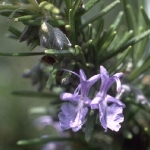
| Common Name: |
Rosemary |
| Other Names: |
Compass Weed, Polar Plant, Rose of the Sea, Sea Dew, Sea Mist |
| Botanical Name: |
Rosmarinus officinalis |
| Genus: |
Rosmarinus |
| Family: |
Lamiaceae |
| Plant facts: |
A member of the Labiatiae family, the everygreen shrub can grow 10-15 feet tall in the United States. When touched, the needles give off a distinct aroma—faintly camphorlike and spicy. When eaten, the needle-shaped leaves have a pungeant, somewhat bitter taste. |
| History: |
The distinctly aromatic rosemary plant, its scent reminiscent of pine, has been used in medicine and cooking for at least 2,000 years. The myths and legends surrounding this ancient herb also stretch back through the millennia. A longtime symbol of love, friendship, loyalty, and remembrance, brides traditionally placed rosemary in their wedding bouquets as a symbol of fidelity and love. Funeral mourners often carried rosemary to protect themselves from graveyard demons, and they would sprinkle rosemary sprigs on the tombs of their loved ones as a promise that they would never be forgotten. The practice of using rosemary as a talisman against evil continued through the Middle Ages, and rosemary sprigs were placed under pillows to chase away evil spirits. Ancient Greek students and scholars wore crowns of rosemary—called coronariums, the plant's Old Latin name—to boost their brain power and improve their memory. The ancient Romans brought rosemary to Britain, where its use became widespread, and the playwright Shakespeare immortalized the herb's memory-boosting powers in this famous line from Hamlet: "There's Rosemary, that's for Remembrance." Rosemary was often substituted for the more expensive incense in sacred rituals; indeed, one of its old French names is incensier. In Spain—where rosemary was once called romero (for "pilgrim")—Christians believed the rosemary shrub was sacred because it had sheltered Mary, Joseph, and Jesus during their escape to Egypt from the Romans. |
| Origin: |
The herb is native to the Mediterranean region, where it grows wild on dry slopes near the coast. In other regions, it is cultivated in herb gardens and is grown as a potted plant. |
| Native Location: |
Mediterranean region, United States, Balkan States, England, France, Morocco, Portugal, Russia, Spain, Tunisia. |
| Cultivation: |
Well-drained, ideally neutral to alkaline soil, in full sun, with shelter in cold areas. Tolerates soil pH 5-8. Remove dead stems and straggly shoots in spring. Prune after flowering to encourage bushy growth. Rosemary dislikes cold, wet winters, and rarely survives prolonged freezing. Affected plants rot at the roots, often remaining green above ground until late spring. They seldom recover, but cuttings can usually be rooted successfully before the plant dies. |
| Propagation: |
By seed sown in spring (species only); by semi-ripe cuttings in summer. |
| Harvest: |
Leaves and flowering tops are collected in spring and early summer, and distilled for oil, or dried for infusions, decoctions, extracts, spirits, and tinctures. |
| Height: |
2m (6ft) |
| Width: |
1.5-2m (5-6ft) |
| Variants: |
Var. Albiflorus
Has white flowers. |
Arp
Is exceptionally hardy, with an open habit and thick, resinous, gray-green, lemon-scented leaves.
Found at Arp, Texas, in 1972. Good flavor for cooking. |
Aureus
(Guilded Rosemary)
Has irregular yellow variegation. |
Benenden Blue
Syn. Collingwood Ingram
Is small growing, with a dense, cascading habit, very narrow, dark green, glossy foliage, and large sky blue flowers. Good for containers. |
Blue Boy
Is dwarf, compact, and free flowering, with very small leaves.
Height: 60cm (24in)
Width: 30cm (12in) |
Fota Blue
Is semi-prostrate and free-flowering, with very dark blue flowers. Rather tender.
Height: 30-45cm (12-18in)
Width: 60-90cm (24-36in) |
Gorizia
Has stout, upright stems, very large leaves, and medium-blue flowers. Good flavor for cooking.
Originated in Gorizia, on the border between Italy and Slovenia. |
Joyce de Baggio
Syn. Golden Rain
Is compact, with golden, green-centered leaves, and dark blue flowers. |
Majorca Pink
Has a columnar, arching habit, small, dull green leaves and mauve-pink flowers.
Height: 1.2m (4ft)
Width: 30-60cm (12-24in) |
McConnell's Blue
Is a spreading, prostrate rosemary, with broad leaves and clear blue flowers.
Height: 30-40cm (12-16in)
Width: 1m (3ft) |
Miss Jessopp's Upright
Syn. Pyramidalis
Is vigorous, with a columnar, upright habit and pale blue flowers. |
Pinkie
Has short gray-green leaves, and pink flowers.
Height: 1.2m (4ft)
Width: 1m (3ft) |
Primley Blue
Has an upright habit and clear blue flowers.
Height: 1m (3ft)
Width: 60cm (24in) |
Prostratus Group
(Creeping Rosemary)
Has an arching to prostrate habit. Good for containers, hanging baskets, banks, walls, rock gardens, and bonsai.
Height: 15-30cm (6-12in)
Width: 60-90cm (24-36in). |
Roseus
Has pink flowers. |
Santa Barbara
Syn. Lockwood de Forest
Has a mounding habit, with very dark green, shiny foliage, and clear blue flowers. |
Severn Sea
Has a spreading, arching habit, narrow leaves, and violet-blue flowers.
Height: 1m (3ft)
Width: 1m (3ft) |
Silver Spires
Has white-variegated foliage. Tends to revert. |
Sissinghurst Blue
Is exceptionally free-flowering and relatively hardy, with an upright habit.
Height: 1-1.2m (3-4ft)
Width: 1m (3ft) |
Sudbury Blue
Has dense, blue-green foliage, an upright habit, and mid-blue flowers.
Height: 1.5-2m (5-6ft)
Width: 1.2-1.5m (4-5ft) |
Tuscan Blue
Is fast-growing, with and upright habit, slightly glossy leaves, and dark blue flowers. Good flavor for cooking.
Height: 1-2m (3-6ft)
Width: 1-2m (3-6ft) |
|
| Hardiness: |
Z7-10 |
| Extraction: |
Steam Distillation |
| Parts Used: |
Leaves. For medicinal purposes, the dried leaves and flowers are used, as well as the essential oil, which is obtained by steam distillation.
Leaves, flowering tops, oil, berries/fruits. |
| Color and Odor: |
The essential oil is colorless and has a warm, sharp, refreshing, and camphorous aroma. |
| Background: |
Important as an ingrediant in a famous toilet water produced in 1370 and named "Hungary Water" after Queen Elizabeth of Hungary, who was reputed to have retained her beautiful appearance into old age. Rosemary is also one of the classic ingredients in Eau-de-Cologne. |
| Chemical Constituents: |
Bitters
Borneol
Camphene
Camphor
Cineole
Pinene
Resin
Tannins
Volatile oils
|
| Properties: |
Stimulant, antispasmodic, carminative, stomachic, tonic, astringent, cleansing, cepahlic, cordial, diuretic, nervine.
An aromatic, restorative herb that relaxes spasms, relieves pain, and increases perspiration rate. It also stimulates the liver and gall bladder, improves digestion and circulation, and controls many pathogenic organisms. |
| Components: |
Rosemary contains large amounts of an essential oil, whose primary constituents are cineole, borneol, thymol, camphor and pinene. The oil is an effective disinfectant and antispasmodic. It also stimulates circulation; by increasing blood flow it invigorates the whole body. The needlelike leaves contain bitters, tannins, flavonoids and nicotinic acid as well. |
| Indications: |
Rosemary is used internally for problems of the digestive tract, particularly bloating and cramps; the herb's antispasmodic properties come into play here. In addition, by increasing production of stomach juices, it stimulates the appetite and promotes digestion. Wine made with rosemary is considered to be a fortifying remedy for nervous agitation, low blood pressure and heart and circulatory weakness; it is especially helpful during convalescence. Rosemary oil applied topically increases blood flow and relieves sore, aching muscles. |
| Known Effects: |
Irritates tissue and kills bacteria (volatile oils)
Astringent
Increases stomach acidity, helps reduce indigestion
Helps expel gas from intestinal tract
Miscellaneous Information:
Rosemary is used as an ingredient in perfumes, hair lotions and soaps.
No effects are expected on the body, either good or bad, when the herb is used in very small amounts to enhance the flavor of food.
|
| Possible Additional Effects: |
May redden skin by increasing blood supply to it
May stimulate appetite
May treat skin infections when used externally
May help treat constipation
Potential diuretic
|
| Extra Tip: |
You can gather leaves from the rosemary shrub all year long. Dry them in an airy, shady place at a temperature less than 95°F, in order to sustain the medicinal power of the essential oil. |
| Blends: |
- Tea Infusion:
Pour 1 cup of boiling water over 1 tsp. of rosemary leaves and strain after 15 min. You can drink 1 cup 2-3 times a day.
- Rosemary Wine:
Add about 1 ¾ oz. of rosemary leaves to 1 qt. of white wine or liqueur. Let the wine and leaves stand for 5 days; then filter. Take 1 tbsp. after meals 2-3 times a day.
- A Bath:
Bring to a boil 1 ¾ oz. of dried leaves or 2 ½ oz. of fresh leaves in 1 qt. of water. COver and let it stand for 15-30 min.; add to warm bathwater.
- Dandruff Rinse:
A hair rinse with rosemary adds life to dull hair and combats a dry, flaking scalp. Pour 4 cups of boiling water over ½ cup of rosemary leaves and 1 tsp. of borax. Steep for 2 hrs.; then strain. Apply ½-1 cup after shampooing and conditioning; don't rinse out. Use the rinse within 10 days.
|
| More Uses: |
A decoction of rosemary in wine helps cold diseases of the head and brain such as giddiness and swimmings, drowsiness or dullness, the dumb palsy, loss of speech, lethargy and falling sickness. It is both drank and the temples bathed with it.
It eases pains in the teeth and gums and is comfortable to the stomach. It is a remedy for windiness in the stomach, bowels and spleen, and powerfully expels it. Both flowers and leaves are profitable for the whites if taken daily. The leaves used in ointments, or infused oil, help benumbed joints, sinews or members.
The oil of rosemary is a soveriegn help for all diseases mentioned. Touch the temples and nostrils with two or three drops or take one to three drops for inward diseases. But use discretion, for it is quick and piercing and only a little must be taken at once.
Nicholas Culpeper |
| Medicinal Uses: |
Internally for depression, apathy, nervous exhaustion, headaches and migraines associated with nervous tension or feeling cold, poor circulation, and digestive problems associated with anxiety. Excess causes abortion in pregnant women and convulsions. Externally for rheumatism, arthritis, neuralgia, muscular injuries, wounds, dandruff, scurf, and hair loss. May be combined with Avena sativa (See, Oats), Scutellaria laterifolia (See, Virginia Skullcap), or Verbena officinalis (See, Vervain) for depression.
Rosemary has antibacterial, antidepressant, antifungal, antioxidant, antispasmodic, calming, digestive, pain-relieving, stimulant, stomach-soothing, sweat-promoting, uterine-stimulating, and vasodilating properties. It also helps regulate and support the liver and gallbladder, and it increases the flow of bile to the intestines, helping rid the body of toxins. Additionally, rosemary leaves and oil are rich in a chemical ingredient called borneol, a substance that stimulates the circulatory system and increases blood flow to the brain and heart. Rosemary is taken internally for anxiety, colds, coughs, depression, fatigue, headaches, indigestion, muscle pain and spasms, poor circulation, and stress. It is used externally for arthritic and rheumatic pain, dandruff, minor wounds, and muscle pains and strains. |
| Uses: |
- Digestive Sytem—Useful for indigestion, stomach pains, colitis, flatulence and constipation. Rosemary is also a good remedy for hepatic disorders such as jaundice, hepatitis, cirrhosis, gallstones and bile duct blockage, being tonic to the liver and gall-bladder.
- Urinary System—Rosemary promotes the flow of urine, thus helping alleviate water retention.
- Circulatory Sytem—Stimulating effect on the heart; promotes circulation and helps to improve eyesight. Normalizes poor circulation and low blood pressure, being an excellent heart tonic. Good for palpitations and hardening of the arteries.
- Respiratory System—Useful for colds, influenza and chronic bronchitis with associated coughs.
- Reproductive System—Good for menstrual cramps and scanty periods.
- Nervous System—Stimulant and tonic to the nerves and useful for all nervous disorders and impairment of sensitivity as well as hysteria and paralysis. Good for headaches, mental fatigue, nervous exhaustion and debility.
- Muscular Sytem—Very good for rheumatic and muscular pain, especially tired, stiff and over worked muscles. Rosemary warms cold limbs, especially during winter, and is particularly good for rheumatism brought on by the cold.
- Skin—A good skin tonic. Rosemary stimulates the scalp and promotes hair growth. Excellent for scalp problems such as dandruff, greasy hair and hair loss.
- Emotions—Clears the mind of confusion and doubt and promotes mental clarity. Rosemary stimulates sensitivity and increases creativity by lifting exhaustion and awakening the heart.
|
| Preparation: |
Rosemary is available as dried and fresh herb and in oils, teas, and tinctures. To make a tea, pour 1 cup of boiling water over 1 teaspoon of dried herb or 2 teaspoons of fresh herb and steep for 15 minutes. Strain, and drink up to 3 cups a day. |
| Culinary Uses: |
Fresh or dried leaves are used to flavor meat (especially lamb and kid), sausages, stuffings, soups, and stews; also to make tea. Very small amounts, often ground or powdered, are added to cookies and jams. Fresh sprigs are steeped whole in vinegar, wine, or olive oil, to give a rosemary flavor to sauces and dressings. Flowers can be added to salads. |
| Economic Uses: |
Extracts are used in hair, skin, and bath products. |
| Warnings and Precautions: |
Do not use rosemary if you are pregnant or trying to conceive. Two types of rosemary oil are available—one for internal use and the other for external application. Do not confuse the two; the oil used externally should never be ingested. The rosemary oil prescribed for internal use is safe in prescribed doses but may cause mild stomach, kidney, and intestinal irritation. Overconsumption of rosemary oil can be toxic.
Don't take if you:
Are pregnant, think you may be pregnant, or plan pregnancy in the near future
Have any chronic disease of the gastrointestinal tract, such as stomach or duodenal ulcers, reflux esophagitis, ulcerative colitis, spastic colitis, diverticulosis, or diverticulitis.
Consult your doctor if you:
Take this herb for any medical problem that doesn't improve in 2 weeks (There may be safer, more effective treatments.)
Take any medicinal drugs or herbs including aspirin, laxatives, cold and cough remedies, antacids, vitamins, minerals, amino acids, supplements, other prescription or non-prescription drugss
Pregnancy:
Don't use unless prescribed by your doctor.
Breastfeeding:
Don't use unless prescribed by your doctor.
Infants and Children:
Treating infants and children under 2 with any herbal preparation is hazardous
Others:
None are expected if you are beyond childhood, under 45, not pregnant, basically healthy, take it only for a short time and do not exceed manufacturer's recommended dose.
Storage:
Store in cool, dry area away from direct light, but don't freeze.
Store safely out of reach of children.
Don't store in bathroom medicine cabinet. Heat and moisture may change the action of the herb.
Safe Dosage:
Consult your doctor for the appropriate dose for your condition.
|
| Toxicity: |
Rated relatively safe when taken in appropriate quantities for short periods of time. |
| Adverse Reactions, Side Effects, or Overdose Symptoms: |
| Signs and Symptoms |
What to Do |
|
| Diarrhea |
Discontinue. Call Doctor immediately. |
| Nausea or Vomiting |
Discontinue. Call doctor immediately. |
| Skin eruptions |
Discontinue. Call doctor when convenient. |
|
| Blends: |
| Bibliography: |
Aromatherapy Blends and recipes by Franzesca Watson Copyright © 1995 Thorsons, Harper Parker Publishing Inc. Pp 160-163
The Complete Natural Guide to Healing Copyright © 1999 International Masters Publishers AB™ Group 1 Card 32
The Encyclopedia of Herbs by Deni Bown Copyright © 1995, 2001 Dorling Kindersley Limited, pp. 348-349
The Modern Herbal Primer by Nancy Burke Copyright©2000 Yankee Publishing, Inc. pp. 123-124
Vitamins, Herbs, Minerals & Supplements The Complete Guide by H. Winter Griffith, MD Copyright©1998 Fisher Books pp. 431-432 |
|